Media resources.
What iCivic is, why it is built this way, and the facts to check it. For an interview, write to us.
Write to the team →Waiting is collective. Enduring it shouldn’t be.
See, plan, report — together.
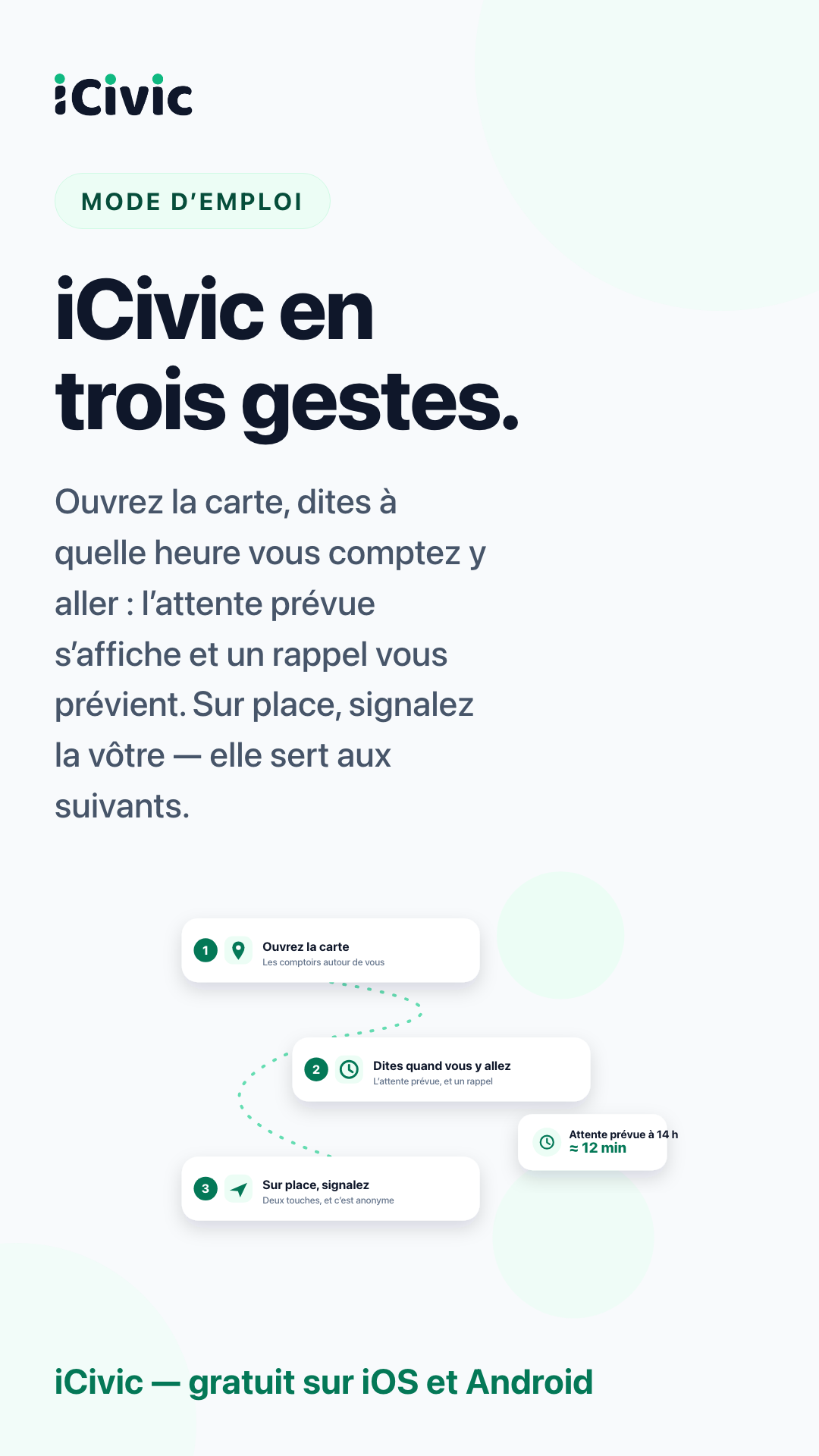
iCivic doesn’t inform citizens: it lets them organize among themselves. The difference comes from the three gestures in sequence, not from any one of them alone.
You see
The wait stops being a surprise you discover on arrival. It becomes something you check before leaving home.
You announce you’re going
The piece nobody has put between citizens yet: by signalling that you’re heading over, we stop all arriving at the same moment. A traffic jam solved by talking to each other, with no authority involved.
You report
On the way out, each person leaves behind what they actually waited — the information the next one needs. With no stored trace of its author, and without their location leaving the device.
Three layers, not a selling point.
AI wasn’t bolted onto a finished app to ride a trend. The platform was built on it, and it works in three distinct places.
Predict
A statistical model, fed by attendance history, answers the only question that really matters: when should I go?
Answer
A conversational agent built to answer citizens directly — which document to bring, where to go, what to expect. It goes live soon.
Operate
Agents assist the platform’s development and watch its infrastructure. That’s what lets a tiny team run a service of this scale.
By design, not by press release.
The question isn’t whether a company says it hosts data in the country. It’s what it agreed to pay for that.
The app’s data is hosted in Quebec
The app’s database, along with support, analytics and technical monitoring, is hosted on our own servers in Quebec rather than with American cloud giants. The few exceptions are named in the privacy policy rather than left unsaid.
Almost as long as building the app itself
Bringing that infrastructure home is invisible work with no feature at the end of it, and it took roughly the same effort as the visible product. It is the most honest measure of the gap between a conviction and a slogan.
Copy-paste, as is.
iCivic est une application mobile québécoise qui permet aux citoyens de voir l’attente dans les services publics avant de partir, d’annoncer leur venue pour que tout le monde n’arrive pas au même moment, et de signaler ce qu’ils ont réellement attendu une fois sur place. Voir, planifier et signaler — ensemble. Là où des données officielles existent, elles alimentent l’application; là où aucun flux n’est publié, l’information vient des signalements citoyens, sans trace conservée de leur auteur et vérifiés par proximité sur l’appareil. Un modèle statistique recommande ensuite le meilleur moment pour se déplacer. L’intelligence artificielle et la souveraineté des données ne sont pas des ajouts : la plateforme est bâtie dessus, et les données de l’application sont hébergées au Québec. Fondée à Gatineau, iCivic est gratuite et sans publicité. L’application est actuellement en bêta dans la région de l’Outaouais. iCivic est un service indépendant, non affilié aux organismes mentionnés.
iCivic is a Quebec-built mobile app that lets citizens see the wait at public services before they leave, announce that they are heading over so everyone doesn’t show up at once, and report what they actually waited once there. See, plan and report — together. Where official data exists, it feeds the app; where no feed is published, the information comes from citizen reports, with no stored trace of their author and verified by proximity on the device. A statistical model then recommends the best time to go. AI and data sovereignty are not add-ons here: the platform is built on them, and the app’s data is hosted in Quebec. Founded in Gatineau, iCivic is free and ad-free. The app is currently in beta in the Outaouais region. iCivic is an independent service, not affiliated with the organizations named above.
Verifiable, point by point.
- Founded in Gatineau (Quebec) — team in Canada, and app data hosted in Quebec, with a few exceptions named in our privacy policy.
- Current coverage: the Outaouais region, in beta. Hospital ERs and Service Canada offices are fed by open data from the MSSS and the Government of Canada; SAAQ and municipal services are open to citizen reports, as no official feed exists.
- Three data sources: official data (MSSS, Service Canada), GPS-verified community reports, prediction models.
- Free and ad-free — the business model targets public bodies, never the resale of personal information.
- Privacy: four invariants held by the architecture rather than by promises — a report's GPS position is checked on the device and never transmitted, no stored data links a report to an account (anti-abuse works in memory only), no personal information is sold or traded, and every new processing activity goes through a privacy impact assessment before it exists.
- Platforms: iOS and Android.
- Contribution tiers: four tiers in the app — Silver, Gold, Platinum and Q-Tier — reached at 0, 10, 40 and 80 reports. No identity data is ever linked to a report.
- Artificial intelligence: three distinct uses — wait-time prediction, a conversational agent for citizens (coming soon), and internal agents that assist the platform’s development and monitoring.
- Data minimization: the app does not collect what it does not need. This isn’t a stated intention — an automated guard rejects any code change that would send an email address, a name or a phone number to the measurement tools, and it blocks the release.
- Consent: the app’s usage statistics only start after explicit consent, revocable at any time. Only crash reports are sent regardless — with no identifier, IP address or email.
- Individual rights: access, correction, deletion and portability, handled within the 30-day legal deadline, through a single channel published in the privacy policy.
Logos & images.



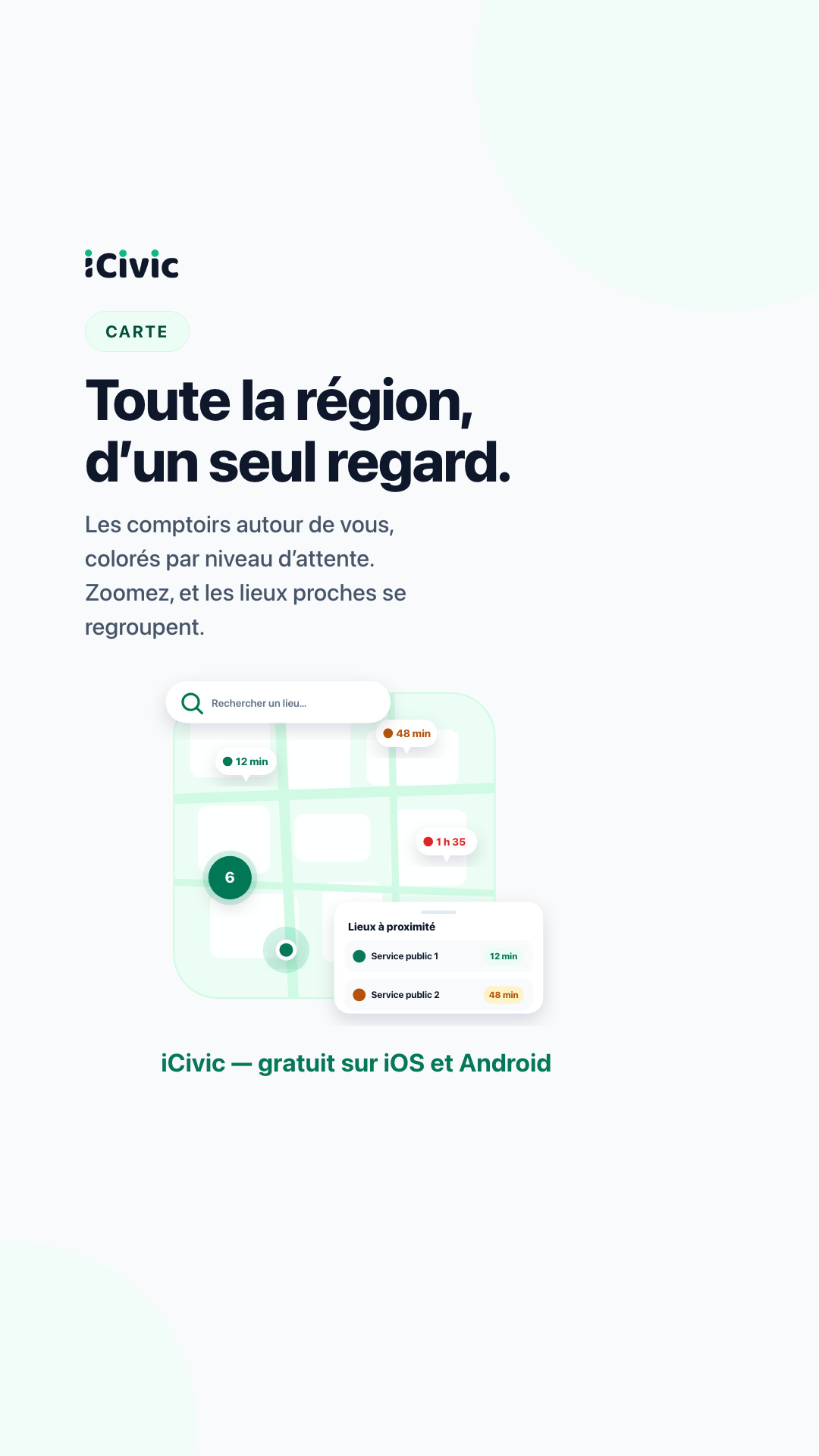
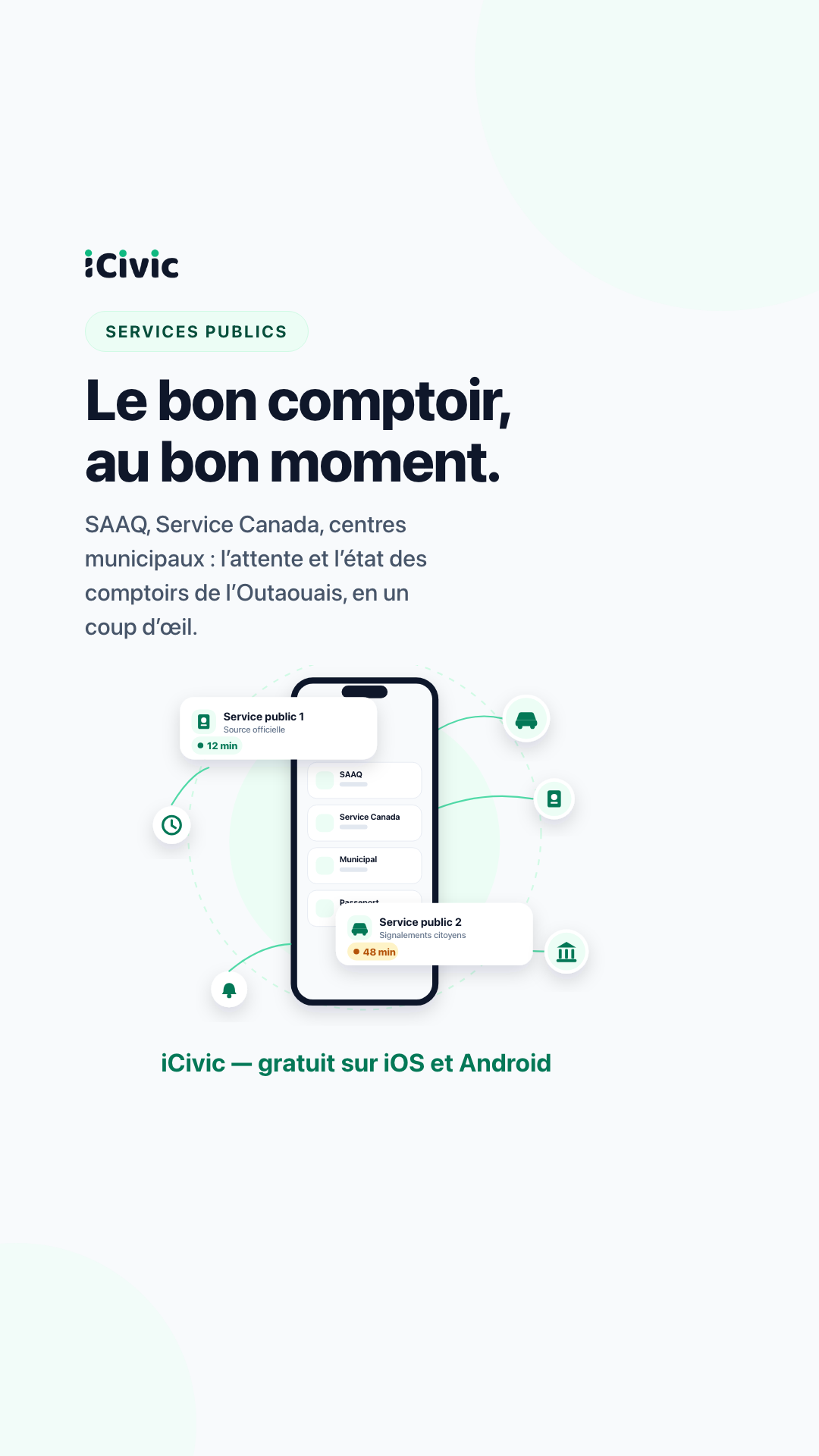
The app, as it presents itself.
Visuals published on the App Store and Google Play listings (French), 1080 × 1920 px. For a raw capture of a specific screen, ask — it will be sent exactly as it appears on the device.
How it works
Citizen reports, proximity-checked on the device — the app in three steps.
Download visual ↓