Building a digital public service with AI from day one: what changes
Concevoir une application civique avec l'IA comme partenaire dès la première ligne de code transforme la façon dont on sert les citoyens de l'Outaouais.

When you start a digital project in the service of the public in 2025, artificial intelligence is no longer a late add-on: it's part of the workshop from day one. At iCivic, we chose this approach to build a tool that helps Outaouais residents plan their visits to public services. Here's, concretely, what that changes — for the team building it, and above all for you using it.
A medical emergency cannot be planned. This article covers non-urgent errands. If you have severe or sudden symptoms, call 911 or go to the nearest emergency room immediately, regardless of how busy it is. Info-Santé 811 is available around the clock.
A shorter development cycle, without sacrificing rigour
Building a civic app means juggling several requirements: reliability, respect for privacy, accessibility, and clear French. AI, used as a design copilot, lets us test hypotheses faster. We can sketch an interface, compare it to recognized accessibility principles, and iterate in a few hours rather than a few weeks.
That gain in speed is only useful if it's kept in check. At iCivic, every decision that touches your data or the quality of the information displayed is reviewed by a human. AI proposes, the team decides. This lets us, among other things:
- rewrite interface messages in a clear, local French;
- check the consistency of labels across screens;
- document technical choices as we go, rather than after the fact;
- explore several usage scenarios before writing final code.
More useful data to plan your visit
Wait times at public services aren't just numbers. They depend on the time of day, the day of the week, the season, and local factors specific to Gatineau and neighbouring municipalities. An emergency room doesn't have the same rhythm on a Monday morning as on a Saturday night. A service counter doesn't see the same clientele at the start of the month as at the end of a quarter.
AI helps shape these patterns so the information displayed is legible at a glance. The goal isn't to predict the future with certainty — no one can do that — but to give you a reliable order of magnitude to decide:
- whether it's worth leaving now or waiting an hour;
- which nearby service point is likely to be calmer;
- when in the week to schedule a non-urgent task.
These benchmarks are especially useful for families with young children, caregivers, shift workers, and anyone who has to deal with transportation to get around the region.
Privacy stays at the centre, not on the edge
Using AI to design a civic tool doesn't mean loosening privacy principles. On the contrary: the more powerful technologies become, the stricter the starting posture must be. iCivic doesn't send your GPS location to its servers. The reports you can make about conditions at a service point are anonymous.
This framework is thought through from the design stage, not tacked on at the end. Concretely, that means every new feature goes through a simple question: do we really need this data to serve you? If the answer is no, we don't collect it. AI helps us spot more quickly the cases where a piece of data could be avoided or processed locally on your device.
A tool that learns from its community
A civic app is never finished. The habits of the Outaouais population evolve, service points change their hours, new needs emerge. AI-assisted development lets us stay responsive without making users wait months for each improvement.
What matters, in the end, is your real experience. A wait avoided, a trip better planned, an evening spent with family rather than in a waiting room. That kind of concrete impact guides every one of our design decisions.
If you live in the region and want to try this approach, open iCivic before your next visit to a public service. You'll quickly see whether the information displayed helps you organize your day better — and if it does, your anonymous reports will help improve the tool for your neighbours.
Related articles

How iCivic's displayed wait times work
Un aperçu clair de la façon dont iCivic estime les temps d'attente aux services publics de l'Outaouais, et de ce que ces chiffres signifient vraiment.
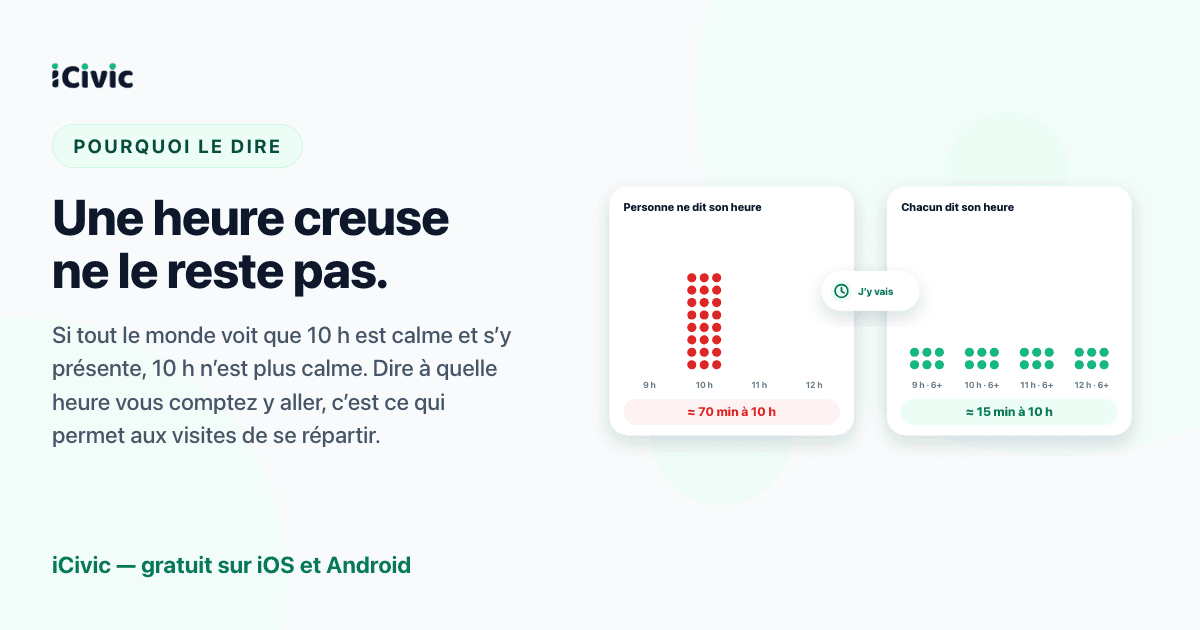
Une heure creuse ne le reste pas
Quand tout le monde vise le même moment calme, il cesse de l’être. Voici comment iCivic aide à mieux répartir les visites aux services publics de l’Outaouais.
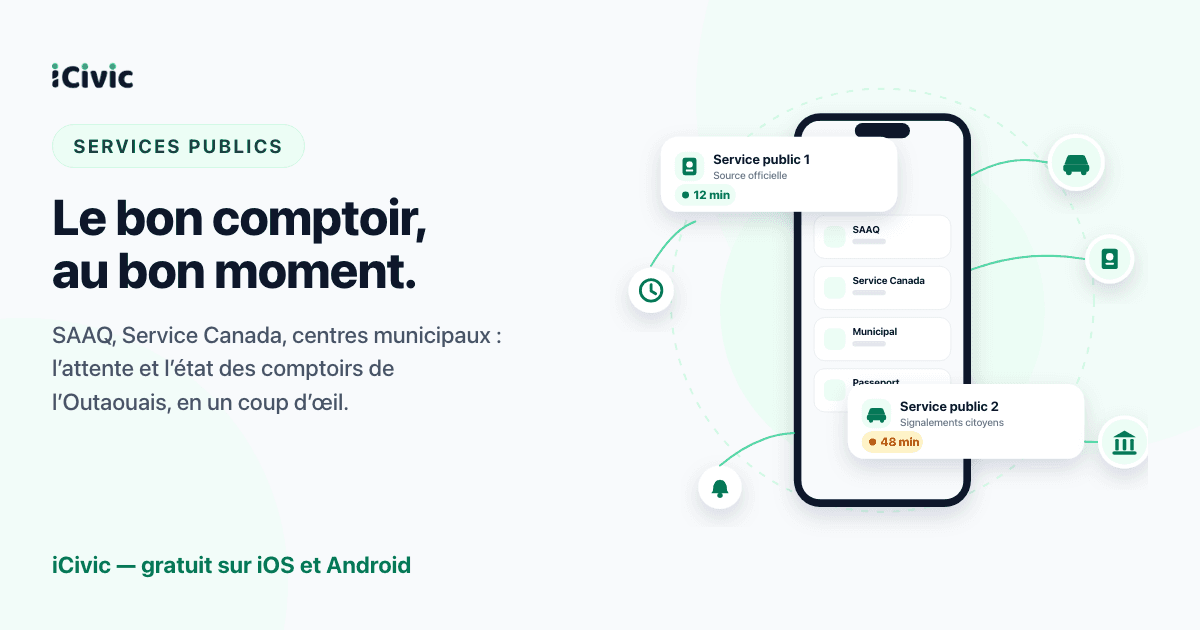
Comparer les comptoirs avec la carte iCivic avant de partir
Un aperçu pratique pour choisir le bon comptoir de service public en Outaouais avant de vous déplacer, à partir des données affichées aux 30 minutes dans iCivic.