Understanding public-service crowds in the Outaouais
Pourquoi les files varient d'une heure à l'autre, et comment ces variations peuvent vous aider à mieux planifier vos démarches dans la région.

Crowding at public services isn't inevitable: it follows fairly predictable rhythms, once you know how to read them. In the Outaouais — where the population blends Gatineau residents, families in rural areas and cross-border workers — understanding these rhythms can literally save you hours of waiting. Here's how crowding works, what drives it, and how to use it in practice.
A medical emergency cannot be planned. This article covers non-urgent errands. If you have severe or sudden symptoms, call 911 or go to the nearest emergency room immediately, regardless of how busy it is. Info-Santé 811 is available around the clock.
What really makes lines vary
A wait time is never random. It stems from several factors that combine, sometimes counter-intuitively:
- Opening hours and shift changes: the start of the day is often busy, then a lull appears in the mid-morning.
- Days of the week: Mondays and the Fridays before a long weekend concentrate a large share of visits, while Tuesdays and Wednesdays are generally calmer.
- Administrative deadlines: renewals, cut-off dates, registration periods. When a deadline lands, crowds climb for several days.
- Seasonality: back-to-school, the arrival of cold weather, flu season, the return from vacation. An emergency room doesn't carry the same load in July as in February.
- One-off events: a storm, a prolonged power outage, a smog episode, a local outbreak. The effect can last several hours after the event.
In the Outaouais there's an added reality: proximity to Ontario shapes the flows. Some services see their clientele fluctuate with cross-border work schedules, especially in the late afternoon.
How to read a displayed wait time
A displayed number — whether it's 45 minutes at a service counter or 3 hours in an emergency room — represents an estimate based on recent reports. It's neither a guarantee nor a fixed average. Read it as a trend at the present moment.
A few useful reflexes:
- Look at the direction of the wait over the last few hours, not just the current value. A 60-minute line that's dropping is more appealing than a 40-minute line that's climbing.
- Compare several service points when you can. In the region, a ten-minute trip to another counter can save you an hour of waiting.
- Factor in the gap between the report and your arrival. A time reported 20 minutes ago stays relevant; a report from 3 hours ago, much less.
- Don't over-read a single report. The more recent contributions there are, the more reliable the estimate.
Planning your visit intelligently
Most non-urgent errands can be planned. Here are simple habits that make a real difference:
- Aim for mid-morning or mid-afternoon, avoiding opening and closing.
- Prepare your documents ahead of time. A complete file cuts your own time at the counter and, by extension, that of the people behind you.
- Check whether an online service exists. Many common tasks no longer require showing up in person.
- Have a plan B. If the displayed wait doubles while you're getting ready, another service point or another time slot may be the better bet.
- For a real medical emergency, never wait based on a number. Displayed wait times apply to ambulatory cases; priority cases are handled quickly.
The community's role
Crowd data is only as good as the people who feed it. Every time a resident reports a wait time on the way out of a service, they make the next visit more predictable for someone else. It's a small civic gesture, anonymous, that directly benefits your neighbours.
iCivic is built around this idea: gather local reports, make them legible, and help you make informed choices without ever sending your location to a server. The data stays useful because it stays respectful.
Next time you have to go to a counter or an emergency room in the Outaouais, take thirty seconds to check iCivic — and, if you feel like it, just as long to share your experience on the way out. That's how we build, together, a faithful picture of the region's public services.
Related articles

Why checking the wait before you go helps everyone
Un simple coup d'œil aux temps d'attente avant de sortir de chez vous améliore votre journée, mais aussi celle de toute votre communauté.
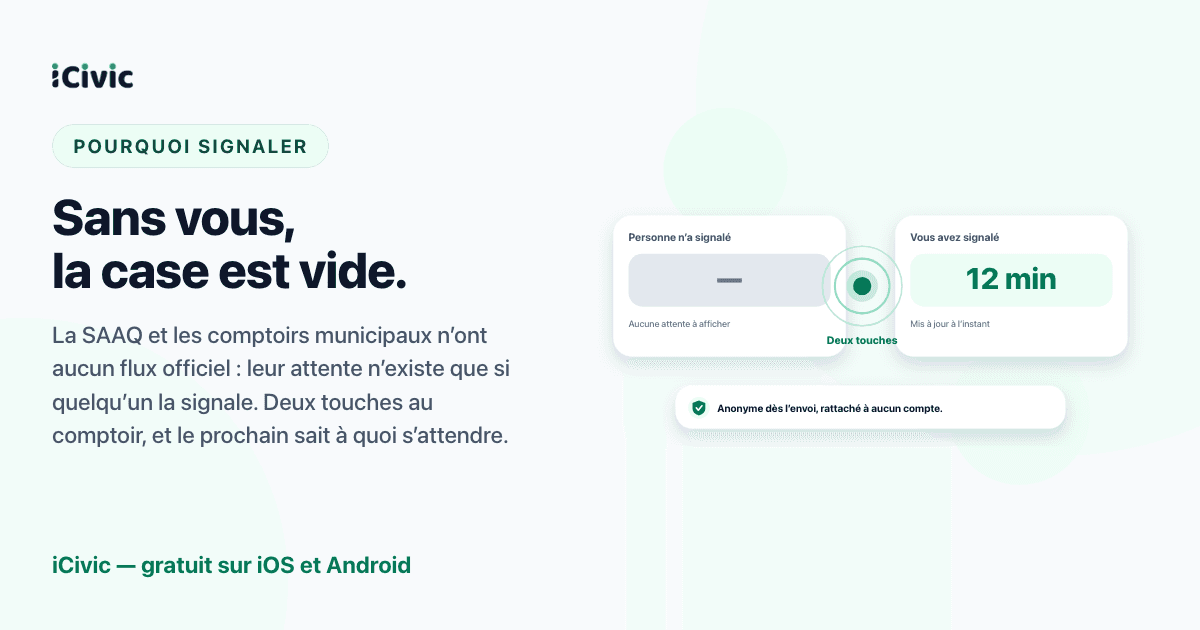
Partager son attente dans iCivic: forme d’entraide civique
Signaler votre attente vécue dans l’appli, c’est offrir aux prochains visiteurs de l’Outaouais une information plus précise et plus utile.
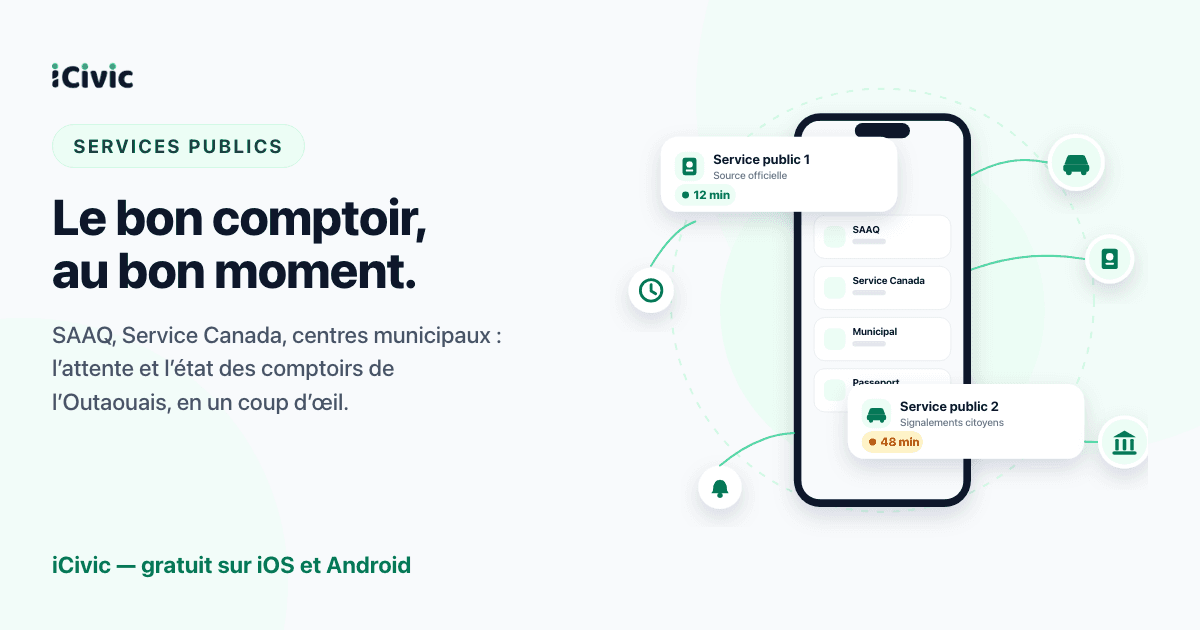
Comparer les comptoirs avec la carte iCivic avant de partir
Un aperçu pratique pour choisir le bon comptoir de service public en Outaouais avant de vous déplacer, à partir des données affichées aux 30 minutes dans iCivic.