Why checking the wait before you go helps everyone
Un simple coup d'œil aux temps d'attente avant de sortir de chez vous améliore votre journée, mais aussi celle de toute votre communauté.

Checking wait times before heading to a public service can seem like a small gesture. In reality, it's a decision with far wider effects than you'd imagine. Whether you're planning a visit to an emergency room, a Service Canada office or a government service counter, taking thirty seconds to check the crowds transforms your experience — and eases everyone else's too.
A medical emergency cannot be planned. This article covers non-urgent errands. If you have severe or sudden symptoms, call 911 or go to the nearest emergency room immediately, regardless of how busy it is. Info-Santé 811 is available around the clock.
A direct benefit for you
The first winner is you. Checking the wait before you leave saves you plenty of hassle. You can:
- pick a less busy moment in the day;
- prepare your documents so you don't have to go back home;
- plan a meal, a snack or some reading if the wait is long;
- arrange childcare or a realistic round trip;
- compare several service points to find the fastest one.
In the Outaouais, the distances between some Gatineau neighbourhoods and service points can easily mean twenty to thirty minutes of driving. Setting out without information sometimes doubles the total length of your errand. Conversely, knowing that a counter shows a moderate wait late in the afternoon lets you plan your day with confidence.
A collective effect that's often underestimated
What's less obvious is the impact of your choice on the community. When many people check wait times and adjust their trips, the load spreads naturally across time slots and service points.
An emergency room, for example, can't turn patients away: it treats everyone according to severity. But when people whose errand can wait choose a less busy moment, the pressure spreads across the day and staff gain time for critical situations. It's not a strict rule, just a common-sense principle that, applied by thousands of people, makes a real difference.
The same reasoning holds for service counters. When one line is very long, other points sometimes offer the same service in ten minutes. Spreading out the visits reduces pressure on staff, improves the mood on site, and lowers frustration for everyone.
How to read the displayed times
A wait time isn't a guarantee: it's an estimate based on recent user reports and observed trends. So read it with a bit of nuance.
- A wait shown at a given moment mostly reflects the last hour. It can change.
- Some services work by priority (triage), so your personal wait can vary.
- The classic peak hours — opening in the morning, the after-lunch return, late afternoon — often stay busier.
- Mondays and the days following a statutory holiday are frequently busier.
Keeping these points in mind, you use the information as a planning tool, not as a promise.
Small gestures that keep a system running
Contributing is as simple as checking. After your visit, taking a moment to report your own wait helps the next users. On iCivic, reports are anonymous and your location is never sent to our servers — only the information you choose to share (the place and the duration) is used to help the community.
This virtuous circle — check, travel at the right time, report in turn — is what makes the data useful. Without local participation there's no reliable picture. With it, every Outaouais resident becomes a small part of a collective information system.
A habit worth building
Getting into the habit of checking before you leave takes little effort. Over time it becomes a reflex, just like checking the weather or the traffic. Your errands get smoother, your stress goes down, and without even thinking about it you help ease the pressure on the region's public services.
Next time you plan a visit to a public service in the Outaouais, open iCivic for a few seconds before you go. You'll save time — and save someone else some too.
Related articles

Understanding public-service crowds in the Outaouais
Pourquoi les files varient d'une heure à l'autre, et comment ces variations peuvent vous aider à mieux planifier vos démarches dans la région.
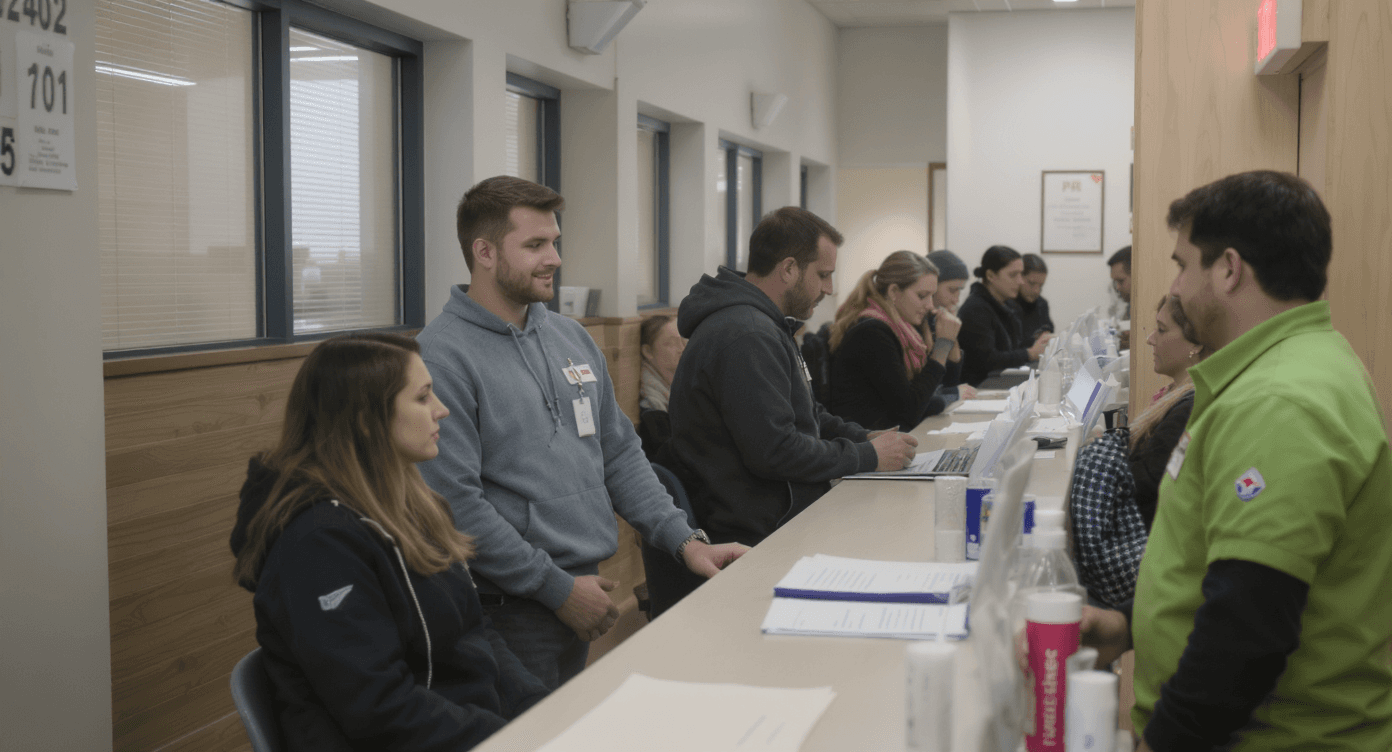
How to avoid peak hours at public services
Un guide pratique pour choisir le meilleur moment de vous présenter à une urgence, une clinique ou un comptoir de service en Outaouais.
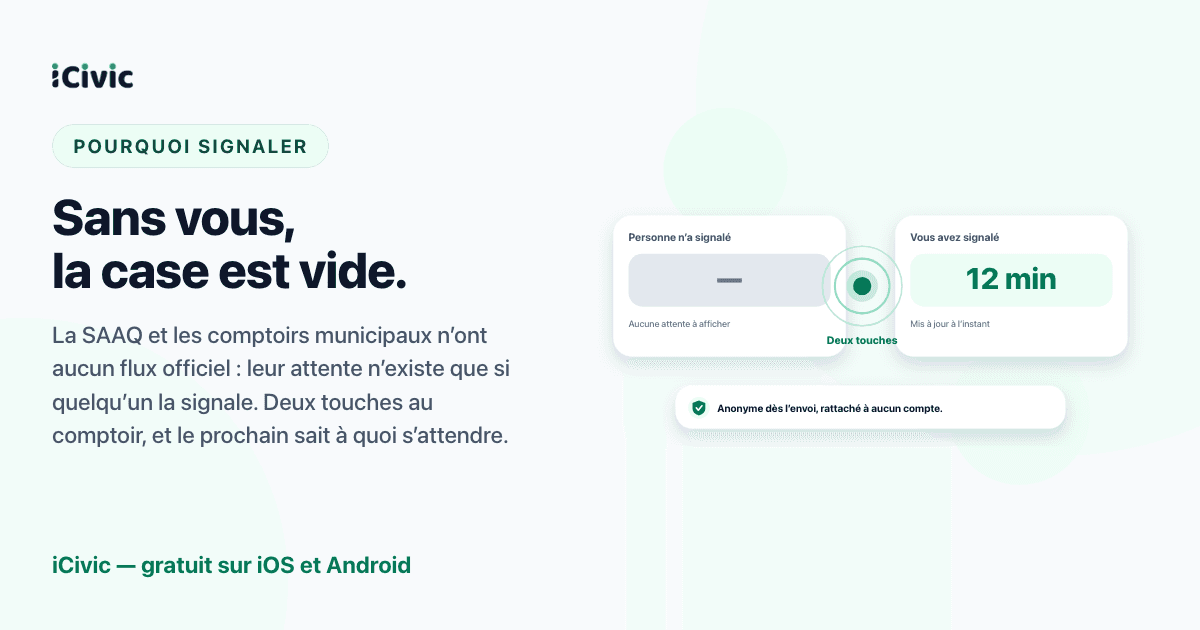
Partager son attente dans iCivic: forme d’entraide civique
Signaler votre attente vécue dans l’appli, c’est offrir aux prochains visiteurs de l’Outaouais une information plus précise et plus utile.