A passport, a 40-minute drive, and an hour and a half in line.
Comment une frustration ordinaire a donné naissance à iCivic.
Some mornings you set out confident. A passport to renew. Office opens at 8:30. You tell yourself: if I get there early, it should be fine.
Forty minutes of driving. A parking spot found. A line visible from the sidewalk.
An hour and a half later, you leave with the precious document, shoulders slumped and the certainty that you have just lost something you will never get back: an hour and a half of an ordinary day.
What made it especially frustrating was not the wait itself. It was realizing, on the way out, that the information existed. Somewhere in the office's systems there had to be a number — how many people were in the waiting room, the average time since morning. Staff knew. Managers probably knew. But we, the people who had driven forty minutes, did not know. We couldn't know.
The information was there. Just not where it needed to be. Not at the right time. Not in a useful form.
That frustration is where iCivic was born. Not from a spreadsheet, not from a market study. From a very concrete, very ordinary moment that everyone recognizes instantly when you describe it.
"Oh yeah, for me it was the SAAQ." "For me it was the ER, on a Wednesday night." "For me it was Service Canada, two hours for nothing."
Everyone has their own version. Because the problem is structural, not accidental. Public services have predictable peaks — Tuesday afternoons, Monday mornings, the days before month-end. These patterns exist. They repeat week after week, season after season. And yet the citizen sets out in the dark, each time as if it were the first.
The conviction behind iCivic is simple: wait times at public services are a matter of public interest. Not commercial data, not an operational secret — data that belongs, in a sense, to everyone who pays for these services.
Making that information visible, verifiable and accessible to all, with no account, no paywall, no paperwork — that is the most basic piece of civic infrastructure in the world.
Telling one another how long it takes.
The same goes for the next citizen trying to find out whether the office is packed or empty at 10 a.m. on a Wednesday. They don't want to repeat our mistake. They want to leave at the right time.
That is what iCivic predicts. Not perfectly — nothing is perfect. But to within fifteen minutes, over a forty-eight-hour horizon, in the Outaouais, right now.
Because renewing a passport shouldn't cost you a morning.
Related articles
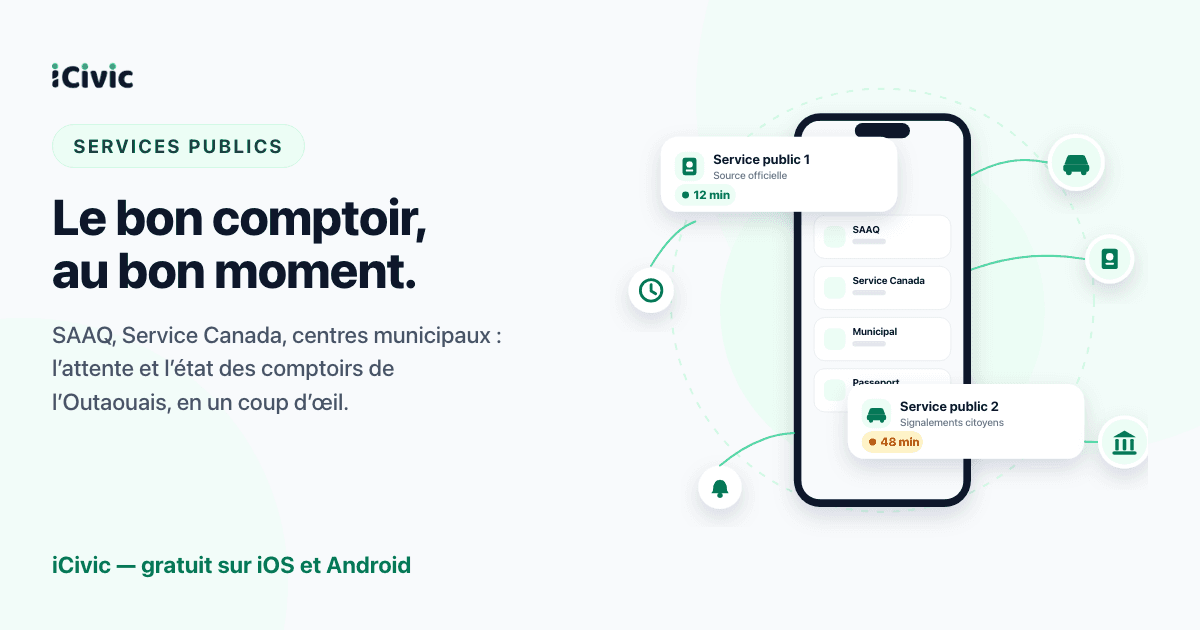
Comparer les comptoirs avec la carte iCivic avant de partir
Un aperçu pratique pour choisir le bon comptoir de service public en Outaouais avant de vous déplacer, à partir des données affichées aux 30 minutes dans iCivic.
Temps d'attente en Outaouais : ce que disent vraiment les chiffres
Ce que révèlent les temps d'attente observés dans les services publics de l'Outaouais, et comment mieux planifier vos démarches au quotidien.

Understanding public-service crowds in the Outaouais
Pourquoi les files varient d'une heure à l'autre, et comment ces variations peuvent vous aider à mieux planifier vos démarches dans la région.